Posted by Jenny
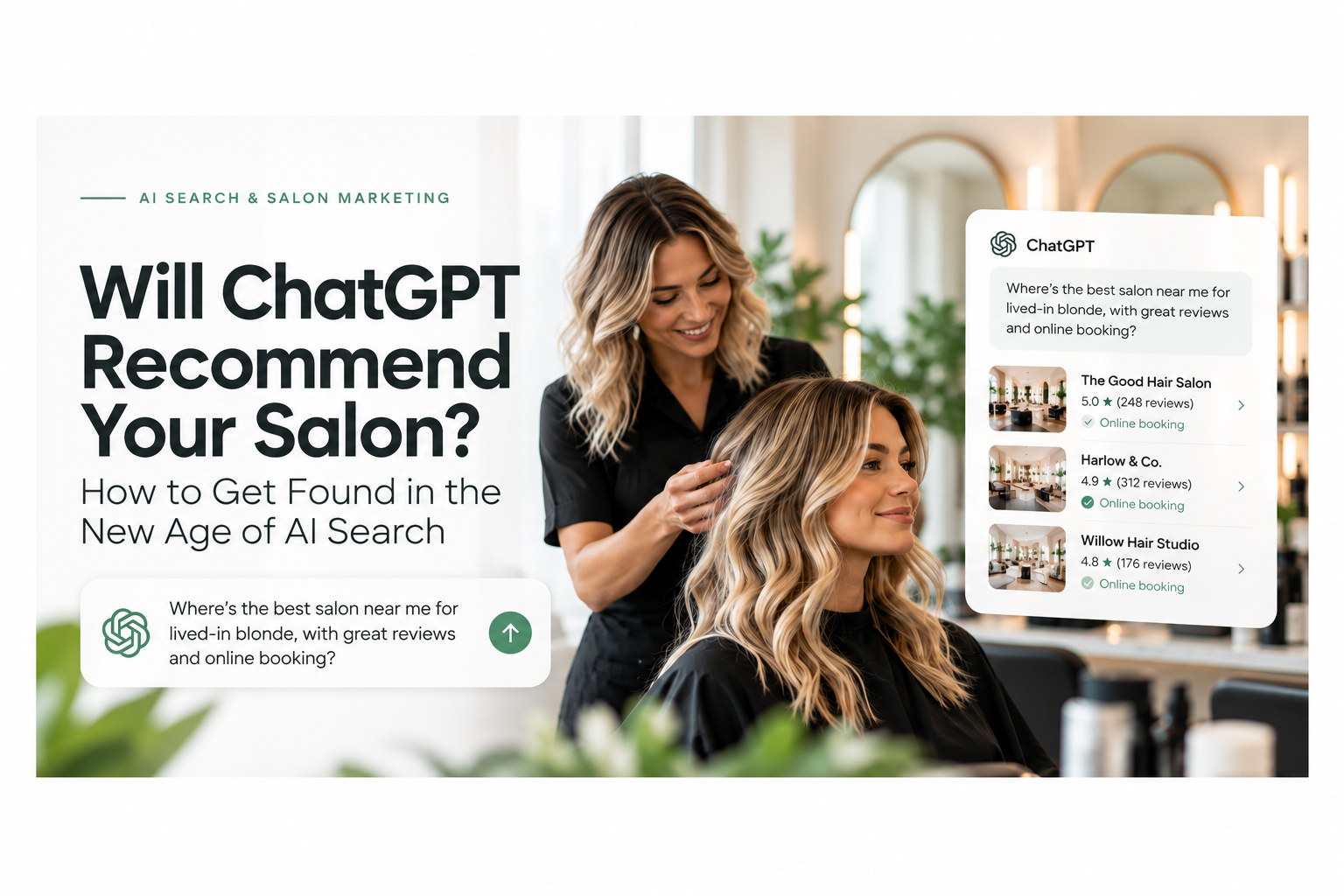
The way clients discover salons is beginning to change. Instead of simply searching Google for “hair salon near me”, potential clients can now ask AI tools to recommend the business that best matches exactly what they need.
Imagine somebody looking for a new hair salon. Instead of scrolling through pages of search results, they open ChatGPT and ask:
A beauty client might ask for a highly rated salon specialising in brows that opens late on Thursdays. Someone looking for a clinic could ask for local recommendations for a particular skin concern. A client who has just moved to the area might simply ask for the best barber nearby that can be booked online.
These searches contain far more context than the short keywords we have spent years optimising websites around. Instead of simply asking for a list of businesses, the potential client is asking for a recommendation.
Let’s clear up one thing first: Google isn’t disappearing. Your Google Business Profile, website, reviews and local SEO still matter enormously. In fact, as search becomes more conversational, the information that exists about your business across the web may become even more important.
ChatGPT can search the web when a question requires current information and provide answers supported by web sources. Public websites can also be eligible to appear within ChatGPT search.
The change, therefore, isn’t necessarily where the information comes from. It is how potential clients can access and interpret it.
Traditional search often presents somebody with a list of possibilities and leaves them to do the research. They open websites, compare reviews, check services and decide which business looks right. Conversational AI can help with some of that research by allowing someone to describe exactly what they want, where they are, what matters to them and even what concerns they have.
This is where the subject becomes much more useful than simply talking about “the future of AI”. You can test your own salon right now and see how clearly the internet understands your business.
Open ChatGPT and ask a question that one of your ideal new clients might genuinely ask. Don’t search for your business name because that makes the test too easy. Instead, ask for a recommendation based on the service, location and experience that matter to your clients.
Then look at the answer critically. Does your business appear? If it does, look beyond the fact that you were mentioned. What information has been used to understand your business? Which sources are being referenced? Are your services, opening hours, location and booking options represented accurately?
If you don’t appear, don’t panic. AI-generated recommendations can vary, and this isn’t a fixed league table. The useful part is understanding why the businesses that do appear are easy to identify and recommend.
That exercise alone can reveal valuable gaps in your digital presence. You may discover that a competitor has a clearer service page, stronger recent reviews, better local information or a much easier online booking journey. Those are all things you can improve.
This is where many beautiful salon websites may have a problem. They look polished, they feel premium and they reflect the brand beautifully, but they sometimes forget to say, clearly and quickly, what the business actually does.
Imagine two fictional salons. Both are brilliant. Both have talented teams. Both deliver an excellent client experience. The difference is how clearly their online presence explains why somebody should choose them.
Lovely copy. But where is the salon? What does it specialise in? Who is it particularly good for?
There is very little ambiguity. The business is immediately easier to understand.
This doesn’t mean every salon website needs to become a dull collection of keywords. Please don’t do that. Your personality, positioning and brand still matter enormously.
It does mean that underneath the beautiful imagery and clever copy, your digital presence needs substance. A potential client, search engine or AI system should be able to understand who you are, where you are, what you specialise in and why somebody might choose you.
Your website has always communicated with more than humans. Search engines crawl and interpret its content too, so this part of digital marketing isn’t entirely new.
What AI search does is make the importance of that machine-readable information much easier for business owners to see.
OpenAI explains that websites wanting their content to be discoverable in ChatGPT search should allow its search crawler access to their site. That does not mean allowing access guarantees inclusion or a particular position in an answer, but it does give salon owners a useful technical question to ask whoever manages their website.
Specificity could become one of the biggest advantages independent salons have.
A website that simply says Hair | Beauty | Nails | Skin | Bridal | Extensions | Colour has technically communicated its services, but it hasn’t necessarily communicated what the business is known for.
Those descriptions create context. They give both potential clients and technology a clearer understanding of when that business might be particularly relevant. You don’t have to stop offering everything else. The goal is to make your areas of expertise unmistakable.
Reviews have always influenced potential clients, and they remain an important part of local search. Google says that review count and review scores can contribute to local ranking alongside factors including relevance, distance and prominence.
But there’s another way to think about reviews now: evidence.
Your website can say you specialise in balayage. That is a claim made by the business. If dozens of genuine clients independently mention your colour consultations, balayage results, colourists and experience, the wider digital footprint around your salon begins to reinforce that positioning.
Both are fantastic feedback to receive, but the second tells someone far more about what the salon does and the experience it provides.
That doesn’t mean scripting reviews for clients. Genuine reviews should stay genuine. It does mean that consistently generating fresh feedback deserves to be treated as an ongoing part of your marketing strategy, rather than something you remember to focus on twice a year.
Your website says you close at 8pm. Google says 6pm. Facebook still displays an old telephone number, while a directory you forgot existed lists the address you left three years ago.
Individually, those inconsistencies can seem minor. Collectively, they create uncertainty.
Google recommends keeping Business Profile information complete and accurate, and its local search systems draw on information from multiple sources, including official websites, third-party data, business owners and users.
Check your website, Google Business Profile and the main places your business appears online. They should all tell the same story.
This is the part I think the salon industry should get genuinely excited about. You already have one of the most valuable ingredients for building a stronger presence in search and AI: real expertise.
Every day, your team answers questions that matter to real clients. You explain treatments, manage expectations, solve problems, recommend services and reassure people who may be nervous about trying something new. That knowledge shouldn’t exist only inside the salon.
Those questions aren’t only being asked while somebody is sitting in your chair or treatment room. Potential clients are typing them into Google and increasingly asking them conversationally through AI tools.
So answer them.
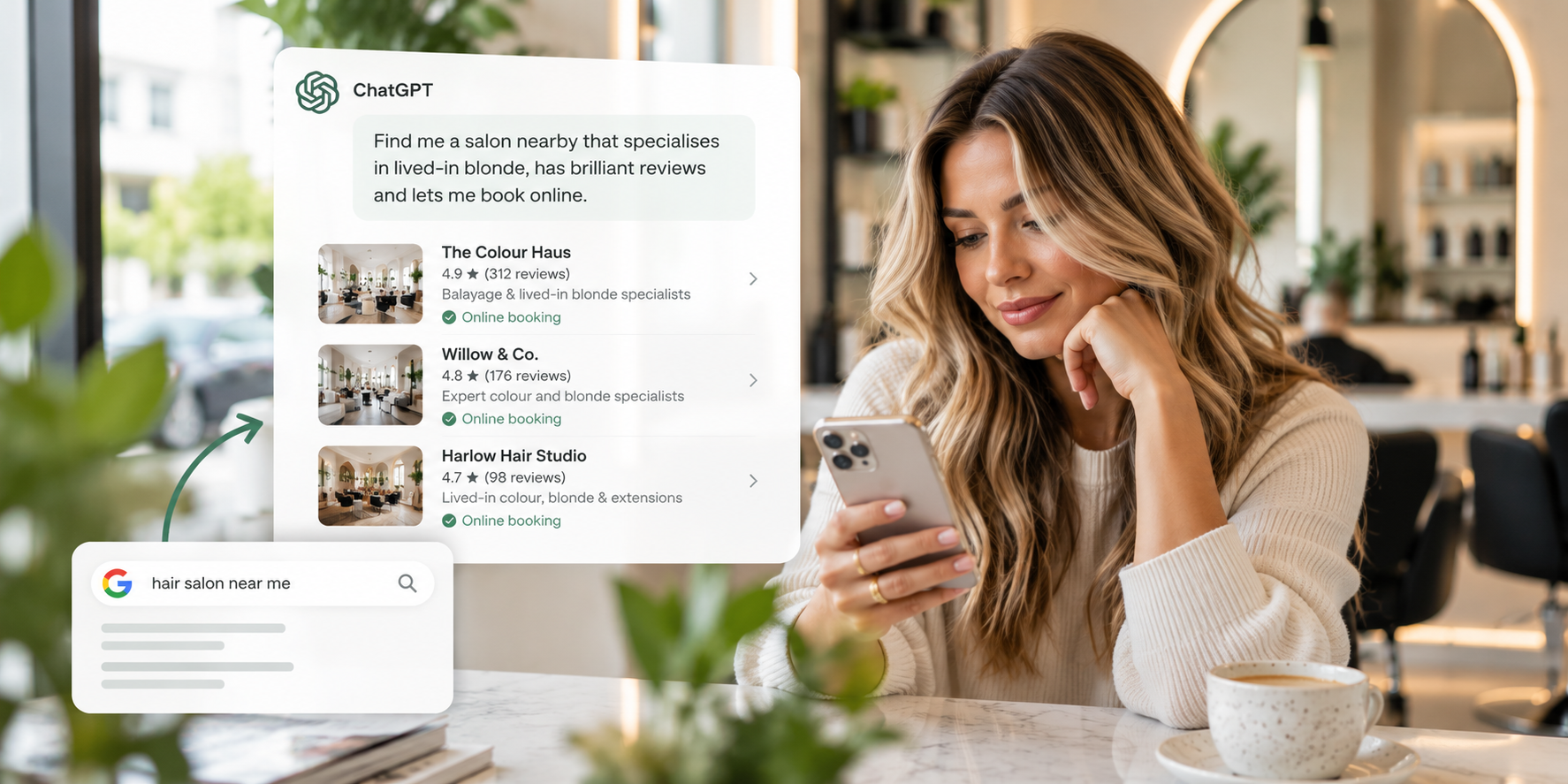
Your website doesn’t have to be an online brochure containing little more than an About page, service menu and booking button. It can become a useful library of genuine expertise built around the questions your clients and potential clients actually have.
A thoughtful treatment guide, FAQ, case study or article written from real salon experience can demonstrate expertise in a way that generic filler content simply can’t.
For years, local salon search has revolved around relatively simple phrases such as hair salon near me, beauty salon Bournemouth or barber Manchester.
Conversational AI makes much richer searches feel completely natural. Instead of searching by location alone, potential clients can explain their needs, preferences and concerns in one question.
These aren’t simply location searches. They’re fit searches.
And that creates a huge opportunity for brilliant independent salons, barbers and clinics. You don’t necessarily need to be the biggest business in town or have the largest marketing budget.
You need a strong enough digital presence to make it clear when your business is particularly relevant to what somebody needs.
There is one important flaw in obsessing over AI visibility: being recommended does not automatically mean being booked.
Imagine ChatGPT recommends your salon. The client clicks through, your website looks beautiful, and for a moment everything is working exactly as it should.
Then they can’t find your prices. They aren’t sure which service to choose. Your booking button is buried halfway through the navigation. The site is awkward on mobile, and eventually they discover they need to call during opening hours.
That is why visibility without conversion is vanity. The goal isn’t simply to appear in more searches. It is to make it effortless for the right client to move from interest to action.
Your online booking journey is therefore part of your marketing strategy, not merely an administrative convenience.
Every unnecessary step between those stages gives a potential client another opportunity to disappear.
It doesn’t need to be complicated. In fact, the best journeys feel almost invisible because everything the client needs is exactly where they expect it to be.
Whether somebody discovers you through Google, Instagram, ChatGPT, a recommendation from a friend or the next platform we haven’t heard of yet, the principle is the same: once their interest is there, remove every avoidable barrier between them and the appointment book.
Please don’t finish this article thinking you now need a six-month “AI optimisation strategy”. You don’t.
You can make a meaningful start in an hour by focusing on the things that improve your visibility for clients anyway: clarity, consistency, expertise and an easy booking journey.
Ask ChatGPT and other search tools the questions your ideal clients might genuinely ask. Don’t obsess over whether you appear first. Look at which businesses are surfaced, what information seems to support the answer and whether the details shown are accurate.
Check that your website, Google Business Profile and the main places your business appears online all agree on your name, location, opening hours, services, telephone number and booking link.
Within a few seconds, can someone understand where you are, what you do, who you serve and what you’re particularly good at? If not, that clarity is worth fixing before worrying about anything more advanced.
Are you generating fresh feedback consistently, or relying on a lovely collection of reviews from years ago? Recent, genuine feedback helps reassure potential clients and strengthens the wider picture of what your business is known for.
“What are the ten questions clients ask us most often?” Write them down. Those questions can become FAQs, service guides, social content and future blog ideas based on real client needs rather than guesswork.
We’re going to hear a lot more about terms such as GEO (Generative Engine Optimisation), AEO (Answer Engine Optimisation) and AI search optimisation.
Some of that will be useful. Some of it will inevitably become noise.
The fundamentals remain reassuringly sensible. Google says local visibility is primarily influenced by relevance, distance and prominence, while OpenAI does not offer a guaranteed way to secure top placement in ChatGPT search. There is no magic switch that suddenly makes AI recommend your salon.
Anyone promising one deserves a raised eyebrow.
Those principles worked before generative AI. They’re becoming even more valuable because of it.
There’s another reason this shift in search matters, and it goes beyond simply getting more people onto your website.
A traditional search result effectively says: here are some businesses that might match what you’re looking for.
An AI-assisted recommendation can potentially arrive with much more context. The potential client may already have explained what they need, what matters to them, where they are and the type of experience they’re looking for.
That means somebody could arrive at your website further through their decision-making process. They haven’t simply discovered your business. They may have discovered it in relation to a very specific need.
SalonIQ can’t press a button and make ChatGPT recommend your salon.
And we wouldn’t pretend it can.
What SalonIQ can do is help strengthen the journey around discovery. Once somebody finds your business, your online booking experience can make it easier for them to take action. Your client data can help you understand who books, returns and spends, while your marketing tools help you continue the relationship beyond that first appointment.
Your reporting and insights then help you understand something even more important: whether increased visibility is actually translating into stronger business performance.
|
01
Get found
|
→ |
02
Get booked
|
→ |
03
Deliver a brilliant experience
|
→ |
04
Get rebooked
|
Because ultimately, being found isn’t the business goal. Being found by the right client, converting that interest into a booking, delivering a brilliant experience and giving them a reason to return is. That’s the full journey, and that’s where sustainable growth happens.
There’s one thing I’d encourage every salon owner reading this to do today.
If your salon appears, investigate why. Don’t assume the job is finished.
If it doesn’t, investigate why. Don’t assume you’ve lost.
Look at the businesses being surfaced, the sources being referenced and what those businesses communicate clearly. Then compare that with your own digital footprint and start strengthening the areas that need attention.
The way people discover businesses is changing, but the opportunity isn’t about gaming a new algorithm. It’s about making your salon easier to understand, easier to trust and easier to choose.
See how SalonIQ brings together online booking, client marketing, reporting, automation and intelligent tools to help you build a stronger, more connected salon business.
Call a member of our team today on 01892 280 123