Posted by Tom
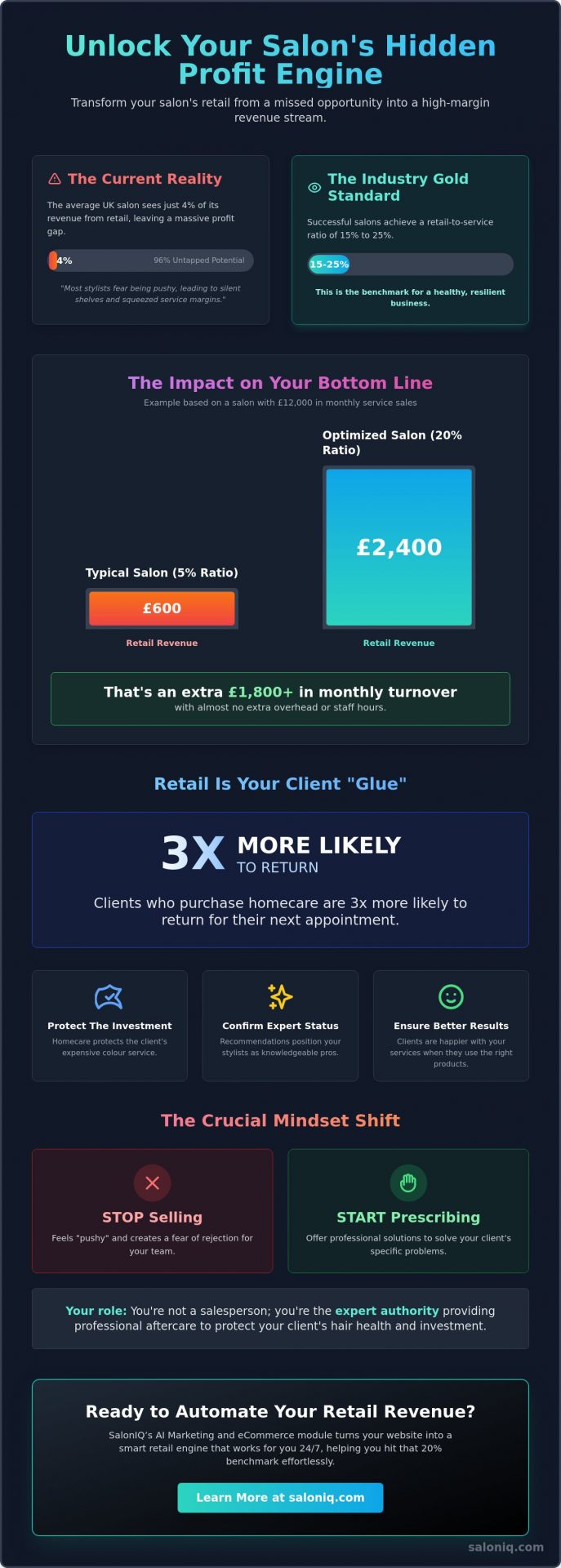
Did you know that the average UK salon sees just 4% of its total revenue come from retail, despite the potential for it to contribute over 20% of your bottom line? It’s a massive missed opportunity that leaves vital profit on the table. We understand the frustration of watching premium professional products gather dust while your clients head straight to Amazon to buy their shampoo. Most stylists genuinely fear rejection and hate the idea of feeling pushy, which often leads to “silent” shelves and squeezed margins on your services alone.
We believe your retail should work as hard as you do. This guide focuses on increasing salon retail sales uk by shifting the focus from selling to solving. You’ll discover how to transform your salon into a high-margin profit engine using proven industry strategies and smart automation built by salon owners for salon owners. We’ll show you how to motivate your team to earn more commission and implement systems that sell for you 24/7. From clearing dead stock to hitting a consistent 20% retail-to-service ratio, here is your roadmap to a more profitable business.
Most salon owners are stuck in a cycle of trading time for money. You’ve only got a set number of chairs and a finite amount of hours in the working day. To grow your revenue, you usually have to work longer hours or hire more staff. Retail is different. It’s the only part of your business that scales without adding a single minute to your treatment clock. In 2026, increasing salon retail sales uk is the most direct path to boosting your profit margins without burnout.
For UK high-street salons, the gold standard for a healthy business is a retail-to-service ratio of 15% to 25%. If your current retail sales sit below 10%, you’re missing out on a massive revenue stream that requires zero extra labour. While inflation has squeezed service margins by driving up energy bills and product back-bar costs, retail profits remain remarkably stable. It’s the key to making your business more resilient and profitable.
Relying solely on chair-time is a dangerous trap. Your income is capped by the physical limits of your team. When a client cancels or the diary has quiet gaps, your revenue stops instantly. Retail products provide a passive revenue stream that keeps the cash flowing even when the chairs are empty. It’s about working smarter, not harder. To see where you stand, calculate your ratio today: divide your total monthly retail sales by your total service sales and multiply by 100.
If your service sales are £12,000 and retail is only £600, your ratio is 5%. You’re leaving thousands of pounds on the table. Moving that ratio to 20% would add an extra £1,800 to your monthly turnover with almost no extra overhead. Upselling is a sales technique that helps you reach these targets by simply matching the right product to the client’s specific hair or skin needs. It’s about professional advice, not a hard sell.
Retail is the “client glue” that keeps people coming back. Industry data confirms that clients who purchase professional homecare from your salon are 3x more likely to return for their next appointment. When a client buys a product, they’re taking a piece of your expertise home with them. It bridges the gap between appointments and ensures they’re seeing the best results from your work every single day.
By focusing on retail, you follow the ultimate growth formula: More Clients… Spending More… More Often… It’s the fastest way to maximise your ROI and build a powerful, sustainable brand that dominates the local market.
Many salon teams hesitate to recommend products because they fear looking like a pushy car salesperson. This mindset is the biggest barrier to increasing salon retail sales uk. If a client leaves your chair with a £150 colour service but uses a £3 supermarket shampoo that strips the pigment, you haven’t done them a favour by staying silent. You’ve allowed their investment to wash down the drain. Shifting from a “selling” mindset to a “prescription” mindset changes everything. You aren’t “flogging” bottles; you’re providing professional aftercare to protect their hair health.
Understanding the psychology of retail is about recognising that clients buy solutions, not just products. When you prescribe a regime, you act as the expert authority. Educate your clients on the “Cost Per Wash” logic. A £20 professional shampoo often lasts three to four months because the formula is highly concentrated. Compare this to a £5 high-street alternative that is 80% water and requires double the amount per application. The professional choice is often more economical over 12 weeks while delivering vastly superior results.
The retail journey starts the moment the client sits down. Use the initial chat to identify “pain points” like split ends, lack of volume, or colour fade. Don’t wait until they are at the till to mention products. Narrate the service at the backwash. Explain exactly why you chose a specific mask or toner. Follow the “Three Product Rule” for every client: recommend one product to cleanse, one to treat, and one to style. This keeps the routine manageable and results-driven.
You might worry that clients will just find the product cheaper on Amazon. Combat this by highlighting your “professional guarantee.” If a product doesn’t suit them, they can bring it back to you for an alternative, a service no faceless online giant provides. Positioning your salon as a curated choice for their specific hair type creates a sense of exclusivity. Focus on “Salon Only” brands that aren’t easily found in local chemists. This reinforces your status as the gatekeeper to premium hair health. To see which products your team recommends most, you can monitor your retail performance through your management dashboard to reward top performers. This data-led approach ensures your retail strategy remains profitable and targeted.
Stylists often feel “shy” about retail because they view it as an aggressive sales tactic rather than a professional responsibility. In the UK, industry data suggests that 68% of clients actually expect a professional product recommendation, yet many stylists remain silent to avoid feeling “pushy.” Building confidence starts with shifting the mindset from selling to prescribing. When your team understands that increasing salon retail sales uk is about extending the life of a £150 colour service, the conversation becomes supportive rather than transactional.
Your Front of House team acts as the ultimate “closer.” While the stylist plants the seed at the chair, the receptionist reinforces the value at the till. A seamless hand-over is vital. If a stylist tells the desk, “We used the hydrating mask today,” the receptionist can immediately highlight the benefits while processing the payment. This dual-layered approach uses The New Science of Customer Emotions to connect the client’s desire for “salon-fresh hair” with the physical product in their hand.
Ditch the dusty product manuals. Boring theory sessions rarely lead to higher profits. Instead, run “hands-on” workshops where stylists use the products on each other. This builds genuine belief in the results. Teach your team to “speak in benefits” rather than listing ingredients. A client doesn’t care about “cetyl alcohol,” but they do care about “five extra minutes in bed because their hair is easier to brush.”
Fairness drives results. In the UK, the standard retail commission benchmark typically sits between 10% and 15% of the retail price (excluding VAT). To truly move the needle, implement a tiered commission structure. For example, offer 10% on the first £200 of sales, rising to 20% once that target is smashed. This rewards high performers and keeps the momentum high throughout the month.
Balance individual rewards with team goals to maintain a healthy salon culture. If the entire team hits a collective monthly target, fund a team night out or a high-value education day. Linking retail performance to annual reviews ensures that increasing salon retail sales uk remains a core part of their career progression, not just a one-off bonus. Use digital leaderboards to create friendly competition, showing real-time progress toward these targets to keep the energy levels high on the salon floor.
Stop leaving your profit to chance. Systematising your approach is the only way to ensure increasing salon retail sales uk wide becomes a predictable part of your business growth. When you treat retail as a professional extension of your service, your clients feel cared for rather than sold to. UK salons that move from accidental selling to a structured system often see retail revenue jump from 5% to over 20% of total turnover within six months.
Your shelves shouldn’t just look pretty; they need to work for you. Audit your stock to identify “dust-gatherers” that haven’t moved in 90 days. Replace them with “hero products” that solve your clients’ most common problems. Focus on the “Golden Zone,” which is the area between chest and eye level. Products placed here receive 35% more attention from browsing clients. Use testers to encourage sensory engagement. A client who smells or feels a product is 60% more likely to purchase it during checkout.
Selecting “hero products” from specialized ranges like Synergy Therm Cosmetics allows you to offer unique, dermatologically-tested solutions for face and body care that aren’t available in every high-street chemist, giving your retail display a competitive edge.
Data takes the emotion out of management. Use your reporting tools to identify your “retail stars.” These aren’t always your busiest stylists; they are the team members who consistently link products to services. Look for patterns in your “add-on” sales. For example, if 40% of your blonde clients aren’t buying a silver shampoo, there’s a clear gap in your consultation process. Average Bill Value is the total revenue generated per client visit, and it serves as the primary metric for measuring the impact of your retail recommendations on overall growth.
Ready to see how smart tech can transform your shop floor? Book a demo with SalonIQ to streamline your retail operations today.
SalonIQ was built by salon owners for salon owners. We know you didn’t enter this industry to be a pushy salesperson. You’re a creative professional. Our software turns retail from a chore into a seamless part of your client’s journey. By using intelligent automation, you can ensure your clients get the professional care they need while you focus on your craft. It’s the most effective way of increasing salon retail sales uk wide without ever feeling like you’re “selling.”
Our AI Marketing tool acts as a silent partner in your business. It analyses service history to send personalised product recommendations. If a client has a professional colour service, the system knows to suggest a sulphate-free shampoo or a colour-protecting mask. These aren’t random ads; they’re tailored prescriptions that add value to the client’s visit.
Most clients don’t switch brands because they’re unhappy; they switch because they’ve run out and find it easier to grab a bottle at the supermarket. SalonIQ stops this “leakage” by tracking when a client is likely to finish their product. If a 250ml shampoo lasts roughly six weeks, the system sends a “Buy it Again” link directly to their phone at exactly the right time. This reduces friction and makes the re-purchase journey a single-click experience.
You can’t manage what you don’t measure. SalonIQ provides total clarity on your retail ROI with one-click reports. You can see exactly which products are flying off the shelves and which ones are gathering dust. To keep your team motivated, the system tracks staff commission automatically. This saves hours of manual admin time and ensures your stylists are rewarded instantly for their efforts. Explore the full range of SalonIQ Reporting features to see how data can drive your growth.
Our goal is simple: help you get more clients, spending more, more often. By automating the technical side of retail, you create a professional environment where products are seen as essential care rather than optional extras. It’s a smarter way to run a salon.
Retail isn’t just an add-on; it’s the engine that drives your salon’s bottom line. By shifting your team from a selling mindset to a professional prescribing approach, you unlock a massive profit stream. UK industry data shows that retail can account for up to 20% of total turnover, yet many businesses struggle to hit 5%. You don’t need to be pushy to win. You just need the right systems and a team that feels confident in their expertise.
Increasing salon retail sales uk starts with making the process effortless for your stylists and your clients. SalonIQ is the UK’s leading salon management software, built by salon owners for salon owners. We’ve integrated powerful AI marketing and eCommerce tools to automate your retail revenue while you focus on creativity. Stop leaving money on the table and start seeing the ROI your hard work deserves.
Book a SalonIQ Demo to see how our AI can boost your retail sales and join the community of owners taking their business to new heights. You’ve got the talent; it’s time to back it with the smartest technology in the industry.
You sell retail by shifting your mindset from “selling” to “prescribing” professional home care. Think of it as an essential extension of the service; 70% of clients expect their stylist to recommend products to maintain their look. Focus on the specific benefits for their hair health. Use the “Consult, Recommend, Close” method during the appointment to make it a natural conversation rather than a hard sell.
A healthy retail-to-service benchmark for UK salons is between 10% and 15% of total turnover. High-performing salons often reach 20% by integrating product recommendations into every client journey. If your current percentage is below 5%, you’re missing out on significant profit margins. Track this weekly via your dashboard to monitor your team’s progress and identify growth areas.
Most UK salon owners pay between 10% and 15% commission on the profit of retail sales. Some prefer a tiered system where commission increases to 20% once a monthly target, such as £500, is met. This motivates your team to actively work on increasing salon retail sales uk while ensuring the business remains profitable after VAT and product costs.
Yes, selling products online is essential for capturing revenue between physical appointments. Data shows that 60% of consumers prefer a multi-channel shopping experience. An integrated online shop allows your regular clients to restock their favourites 24/7. It also protects your revenue if weather or local issues prevent clients from visiting your physical UK location.
You compete with giants like Amazon by offering personalised expertise and “salon-exclusive” guarantees that big retailers can’t match. Highlight that 30% of professional products sold on third-party sites are diverted or expired. Focus on the value of your professional diagnosis. Offer a loyalty price or a points system through your software to give clients a reason to buy directly from you.
Scalp health treatments and sustainable refill stations are projected to be the top sellers by 2026. Industry reports suggest a 15% year-on-year growth in the “skinification” of hair care. Stocking eco-conscious brands with refillable glass bottles appeals to the 75% of UK consumers who now prioritise sustainability. Focus on high-performance bond builders and UV protection serums to stay ahead of the curve.
Salon software streamlines increasing salon retail sales uk by tracking client purchase history and automating follow-up emails. You can set triggers to remind a client when their shampoo is likely to run out, typically 6 weeks after purchase. Powerful reporting tools also show you exactly which team members need more training and which products are your top earners.
If staff are reluctant to sell, it’s usually due to a lack of product knowledge or a fear of rejection. Address this by hosting monthly “Lunch and Learn” sessions with brand educators. Make retail performance part of their KPIs and include it in one-to-one reviews. When your team understands that professional products ensure their technical work looks better for longer, their confidence grows.
Call a member of our team today on 01892 280 123