Posted by Tom
Why does your till report show a record-breaking £6,000 week while your business bank account feels like it’s barely treading water? It’s a common, frustrating paradox for UK salon owners who work tirelessly but don’t see the cash flow they’ve earned. You’ve likely felt the sting of rising energy bills and product price hikes eating into your takings. Mastering the math of calculating salon service profit margins is the only way to stop the leak and ensure your hard work pays off. We understand the struggle because we’re built by salon owners for salon owners.
You deserve to know exactly how much profit stays in your pocket after every cut, colour, or facial. In this guide, we’ll provide the clear formulas you need to master your menu and ensure every treatment generates the ROI your business deserves. You’ll learn how to audit your overheads, price for profit, and use intelligent software to automate these metrics so you can lead your team with absolute financial confidence.
Running a successful business isn’t just about how many clients walk through your door. It’s about how much money stays in your bank account after the doors close. When you’re calculating salon service profit margins, you’re measuring the percentage of every pound earned that the business keeps after paying all expenses. Many owners fall into the trap of being “busy” but broke because they focus on revenue rather than the bottom line. A salon packed with clients can still fail if the services being performed have razor-thin margins.
By 2026, the industry benchmark for a healthy salon net profit sits between 12% and 18%. Top-performing salons, often referred to as “Enterprise” level businesses, frequently push this toward 20% or higher by streamlining operations. If your margin is consistently below 10%, your business is at risk from even minor economic shifts. Understanding the difference between markup and profit margin is the first step toward taking control of your financial future.
Gross Margin looks at the profitability of individual services before you factor in the big bills. It’s calculated by taking your service revenue and subtracting direct costs like stylist labour and professional products used during the treatment. Gross Margin serves as the primary indicator of service-level health. If your gross margin is low, no amount of marketing will make the salon profitable.
Net Profit Margin is the final number. It’s what remains after you pay for your rent, business rates, electricity, software subscriptions, and VAT. While Gross Margin tells you if your services are priced correctly, Net Profit tells you if your entire business model is sustainable. You need to monitor both to ensure your stylists’ talent is actually generating a return on investment for the salon.
Markup and margin are often used interchangeably, but they’re very different. Markup is the percentage you add to a cost to reach a selling price. Margin is the percentage of the final selling price that is profit. This distinction is vital. For example, if you apply a 50% markup to a £20 treatment, you sell it for £30. However, that £10 profit only represents a 33% profit margin. If you think you have a 50% cushion but actually only have 33%, you’ll likely overspend on overheads.
Using SalonIQ reporting allows you to move away from manual estimates and see real-time margin data. Our software is built by salon owners for salon owners to ensure you have total visibility. Instead of guessing your profits, you can use powerful analytics to see which services maximise your ROI. This insight empowers you to motivate your team and focus on the high-margin treatments that truly grow your business.
Profit isn’t a guess. It’s a precise calculation that separates thriving businesses from those just scraping by. To master your finances, you must use the standard industry formula: (Service Price – Total Cost) / Service Price x 100. This result gives you your gross profit margin as a percentage. While the math is simple, the data you feed into it must be flawless. If a £115 balayage costs you £42 to deliver, your margin is 63.5%. However, if you forget to account for the £3 worth of foils and the £2 refreshment served to the client, your real margin drops instantly. Precision is your only protection against “profit leak.”
The “Total Cost” pillar is built on three non-negotiable foundations: product, labour, and overheads. Excluding even the smallest expense ruins the accuracy of your reporting. Consistent data entry is the only way to ensure your financial forecasting reflects reality. When you monitor these metrics in real-time, you gain the power to adjust prices or reduce waste before your bank balance suffers.
COGS includes every single gram of product that leaves your back-bar. You must account for colour, developer, shampoo, and styling products used during the service. Don’t overlook the “invisible” costs that many owners ignore. This includes gloves, foils, towels, and the coffee or wine offered to your guests. factoring in direct and indirect costs ensures your pricing strategy is rooted in fact rather than hope. SalonIQ inventory management tracks product usage per appointment automatically. This removes the manual guesswork and gives you a crystal-clear view of your actual product spend per service.
Your team is your biggest investment. To succeed when calculating salon service profit margins, you must know the “cost of the stylist” per minute. This calculation goes beyond their basic hourly wage. You must include employer National Insurance (NI) contributions and holiday pay to find the true cost of their time. A Creative Director and a Junior Stylist have very different cost profiles:
By breaking down these costs, you can see which stylists are your most profitable assets. This level of detail allows you to set tiered pricing that protects your margins across every level of the team. Accurate labour tracking is the difference between a busy salon and a profitable one.
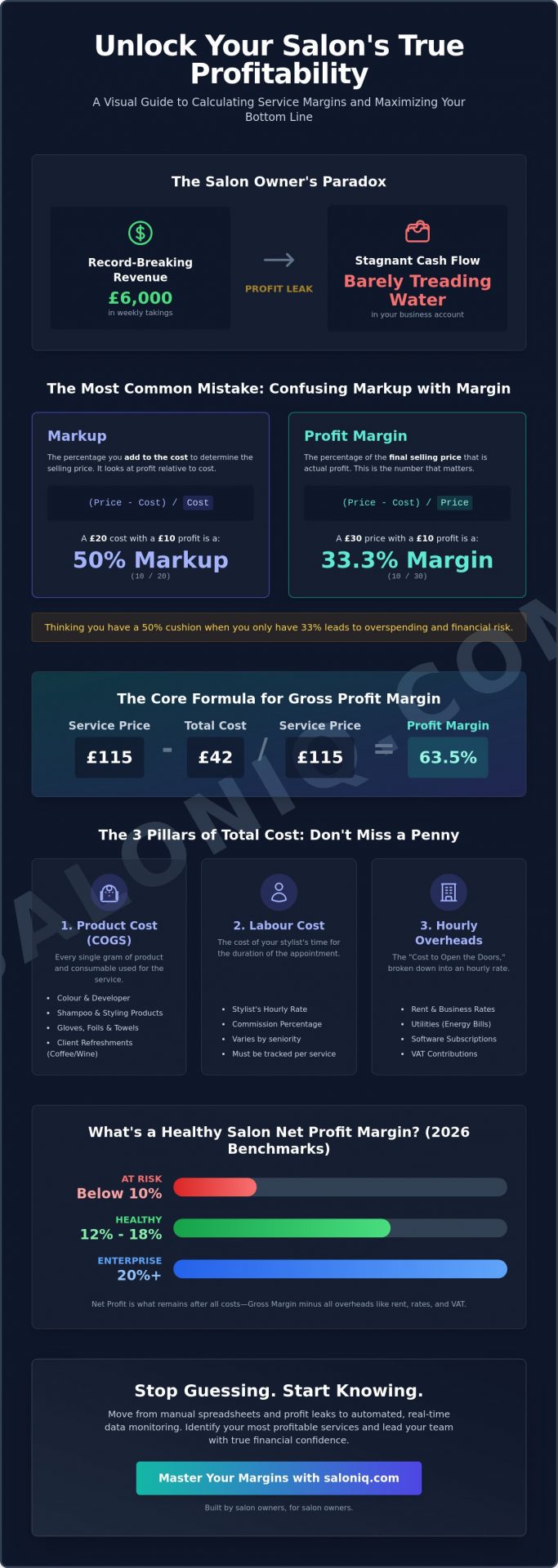
Many owners fall into the trap of thinking profit is simply the service price minus the cost of colour and the stylist’s commission. This logic is a fast track to a struggling business. To stay profitable, you must account for the “Cost to Open the Doors.” These are your fixed expenses like rent, business rates, insurance, and interest on equipment loans. They exist whether your chairs are full or empty.
To master calculating salon service profit margins, you need to determine your hourly overhead rate. Take your total monthly fixed costs and divide them by the total number of hours your salon is open for business. If your monthly bills total £6,000 and you’re open 200 hours, every single hour costs you £30 before you’ve even touched a pair of shears. If a balayage takes three hours, that service must cover £90 of overheads just to break even on the building itself.
You might feel your prices are already at the market limit. If you can’t raise your rates without losing clients, you must focus on efficiency. Profitability isn’t always about charging more; it’s about ensuring every minute in the salon is working for you. By understanding these hidden variables, you move from “hoping” for a profit to “guaranteeing” one.
Precision is vital in the UK market. If you’re VAT registered, remember that 20% of your gross take belongs to HMRC, not your profit margin. Looking toward 2026, energy costs remain a significant concern for high-usage businesses. Dryers, processors, and hot water systems can account for a large portion of your utility spend. Using SalonIQ isn’t just an extra cost; it’s an investment that slashes administrative drag. By automating reminders and bookings, you reduce the need for a full-time receptionist, effectively lowering your hourly overhead rate.
Your “Salon Utilisation Rate” is the percentage of time your stylists spend actually performing services. If a stylist is only 60% utilised, the profit from their active bookings must carry the cost of their 40% downtime. This is why calculating salon service profit margins requires looking at the whole week, not just a single ticket. Gaps in the column are profit killers. Use SalonIQ’s AI team analysis to identify which stylists are your most profitable and who might need support to fill their day. Monitoring these patterns allows you to adjust your margins based on real-world performance, ensuring the salon remains healthy and resilient.
Stop guessing and start knowing. Calculating salon service profit margins isn’t a one-time task; it’s a monthly necessity to keep your business healthy. To begin, perform a “Profit Audit” on your top five most booked services. These high-volume treatments usually account for 60% or more of your total revenue. If the margin is thin on these specific items, your entire business is at risk. You might discover “Loss Leaders” services that look busy but actually drain your bank account. For example, a £45 cut and finish that takes 75 minutes might be losing you money once you factor in UK salon overheads, which often average £30 to £40 per hour per chair.
Open your SalonIQ reports to pull precise average service times and product usage data. Don’t rely on memory; use the hard numbers. Categorise every service on your menu into three groups: High Margin (70%+), Medium Margin (50-69%), and Low Margin (under 50%). This mapping shows you exactly where to focus your marketing efforts. To keep your team engaged during this transition, use “Smart Tips” features to increase staff motivation by showing them how high-quality service directly impacts their own earnings through client gratitude.
The “Value-Based” vs “Cost-Plus” pricing debate is central to your growth. While “Cost-Plus” ensures you cover your bills, “Value-Based” pricing allows you to charge for the expertise and results your stylists provide. If a senior stylist has a 90% rebooking rate, their time is worth more than a simple cost calculation suggests. When you decide to increase prices, focus your communication on the enhanced value. Mention new premium product ranges or advanced training your team completed in 2024. This justifies the change to loyal clients without making them feel undervalued.
Boost your total ticket margin by training staff to upsell high-margin add-ons. A £15 scalp massage or a £20 intensive mask takes minutes but carries a profit margin often exceeding 80%. Monitor the impact of these changes daily through your SalonIQ dashboard to see your average bill rise in real-time. Consistent monitoring ensures you stay ahead of rising utility costs and stock prices in the UK market.
Ready to take control of your numbers? Book a SalonIQ demo today to see how our reporting tools simplify your profit audits.
Stop drowning in manual spreadsheets. Calculating salon service profit margins shouldn’t take hours of your Sunday evening. SalonIQ was built by salon owners who understand that your time is your most valuable asset. Our AI-driven operating system moves you away from guesswork and into real-time precision. You gain total visibility over every pound that enters and leaves your business, allowing you to focus on creative growth rather than tedious data entry.
We focus on a simple, powerful framework: More Clients, Spending More, More Often. By automating the tracking of these three pillars, you don’t just see your margins; you actively expand them. Whether you’re running a single boutique or a multi-site enterprise, the software identifies exactly where your revenue is strongest and where it’s slipping through the cracks. It’s about working smarter, not just harder.
Profit leaks often hide in plain sight within your columns. SalonIQ’s AI identifies these gaps instantly. Perhaps a stylist is over-using expensive colour products or a specific service consistently takes 15 minutes longer than the scheduled time. The system flags these discrepancies so you can take immediate action. You’ll also benefit from automated inventory alerts. This prevents the “dead money” trap of over-ordering stock that sits on a shelf for 60 days. For enterprise groups, personalised reporting brings data from five, ten, or fifty locations into one clear dashboard, ensuring brand-wide consistency in your margins.
Every missed appointment is a direct hit to your bottom line. IQ Pay streamlines the entire checkout process, ensuring every service and retail upsell is accounted for accurately. By implementing automated deposits, many of our users have seen no-show rates drop by 70% or more. This protects your time margin and ensures your team stays productive throughout the day. When you integrate payments, you remove human error and make calculating salon service profit margins a seamless, automatic part of your daily workflow.
The “More Clients, Spending More, More Often” strategy isn’t just a catchy phrase; it’s a data-backed roadmap. SalonIQ tracks client retention and average bill value automatically. If your average client spend drops by even £2, the software alerts you. This allows for immediate marketing interventions or team training sessions. By focusing on these three levers, you ensure that every hour spent behind the chair is as profitable as possible.
Ready to see how much more your business could be making? Book a SalonIQ Demo today to take control of your margins and discover your true ROI potential. Join the team that cares about your success as much as you do.
Stop guessing your growth and start measuring it. Success in the UK hair and beauty industry requires more than just talent at the chair; it demands a firm grip on your numbers. By distinguishing your markup from your true margins and factoring in every pound spent on hourly overheads, you’ll transform your service menu from a list of prices into a roadmap for profit.
Mastering the art of calculating salon service profit margins is the first step toward a sustainable business. It’s about making sure every appointment pays for your expertise, your team, and your future. Don’t let hidden costs erode your hard-earned revenue. You’ve built something incredible, and you deserve to see the rewards in your bank account.
As the UK’s leading salon management software, SalonIQ was built by salon owners for salon owners. Our platform streamlines your operations and provides the powerful data you need to thrive. On average, our partners see a revenue increase of 20% within their first year of use. It’s time to work smarter and maximize your ROI.
Master your salon finances with a free SalonIQ demo and join a community of owners who are taking their businesses to new heights. You’ve got the vision; we’ve got the tools to help you reach it.
A healthy profit margin for a UK hair salon service typically sits between 10% and 20% after you account for all overheads and staff costs. While the industry average often hovers around 7%, high-performing businesses powered by SalonIQ target 25% or higher. Monitoring these figures ensures you remain profitable while maintaining the quality your clients expect from a premium brand.
You should review your salon service prices at least once every 12 months to ensure your business remains sustainable. Many successful owners conduct a review every 6 months to stay ahead of rising utility costs and inflation, which reached 10.5% in 2023. Use your software to monitor booking trends and ensure your rates still reflect your team’s growing expertise and current market conditions.
You must exclude VAT from your profit margin calculations because it’s money you collect on behalf of HMRC, not income for your business. If you’re VAT registered, always work with net figures to get an accurate view of your actual earnings. Calculating salon service profit margins using gross figures will lead to a 20% overestimation of your true take-home pay and could damage your long-term planning.
To calculate the cost, weigh your colour bowls before and after application to find the exact grams used. Multiply this weight by the cost per gram from your supplier invoice, then add 10% for waste and sundries like gloves, foils, or cotton wool. This method provides a precise figure for every tube of tint or scoop of bleach used during the service, allowing for total transparency.
High profit margins are usually more sustainable for independent salons than chasing high volume. A 2022 industry report showed that salons focusing on premium pricing and high margins often see better long-term growth than those relying on discount-driven high footfall. Focus on quality and efficiency to maximise the ROI on every hour your stylists spend on the floor, rather than burning out your team.
Salon software streamlines your operations by automating reminders to reduce no-shows, which can cost UK salons up to £1,200 per month. It allows you to monitor staff performance and track stock usage in real-time to prevent over-ordering. By using SalonIQ, you gain powerful insights into which services offer the best returns, helping you make data-driven decisions that boost your bottom line instantly.
The most common hidden costs include card processing fees, which often range from 1.5% to 3% per transaction, and professional laundry services. Don’t forget the cost of back-bar essentials like towels, capes, and cleaning supplies. These small expenses can erode 5% of your total revenue if they aren’t tracked and factored into your pricing strategy from the beginning.
You can increase your margins by boosting retail sales and reducing product waste through better training. Increasing your retail-to-service ratio by just 5% can significantly improve your overall profitability without changing your price list. Focus on upselling premium treatments and using professional software to manage stock levels efficiently. This ensures you’re generating more from every client visit while keeping your loyal customers happy.
Call a member of our team today on 01892 280 123