A guide to salon marketing

Posted by Jenny

at 12:00am on Thursday 1st Apr 2021

A complete guide to salon marketing

Getting clients through the door — and keeping them coming back — is the real job of running a salon. The treatments, the team, the fit-out: all of it counts for nothing if the appointment book isn’t full.

This guide covers every meaningful marketing channel available to UK salon owners in 2026, from the basics that still work to the newer tools (AI, referral programmes, conquest campaigns) that the best-performing salons are already using.

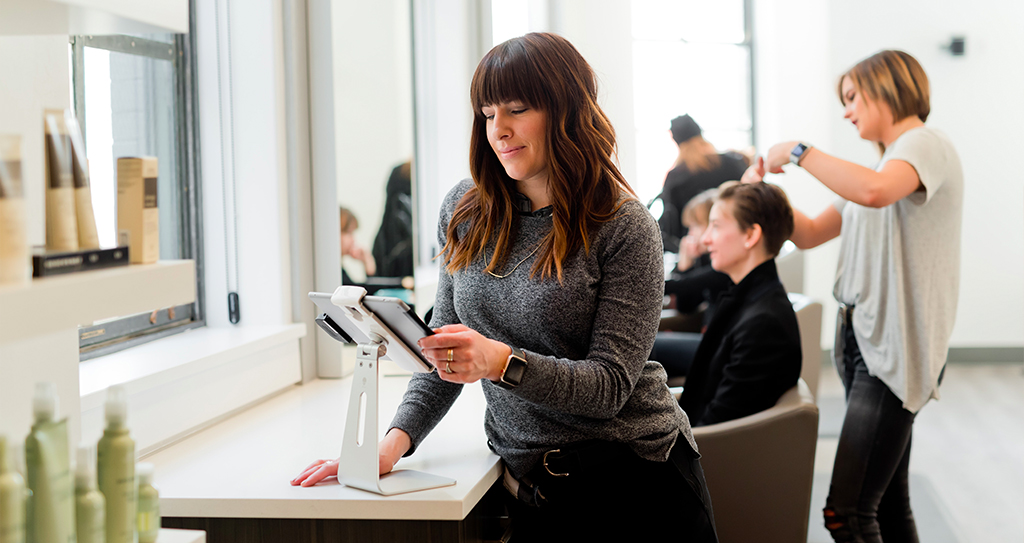
woman checking her phone.


Contents

  1. Social media marketing for salons
  2. Your salon website
  3. Online reviews
  4. Google Business Profile
  5. Paid advertising — Meta and Google
  6. Email marketing for salons
  7. SMS marketing
  8. Referral programmes
  9. AI tools for salon marketing
  10. Loyalty schemes
  11. Marketing a salon group
  12. Building your salon marketing plan

1. Social media marketing for salons

Social media remains one of the most cost-effective ways to reach new clients — but consistency matters more than volume. Posting on two or three platforms regularly will outperform sporadic bursts across six.

What works in 2026:

  • Before and after content — still the highest-performing format for hair and beauty. Always ask client permission before posting.
  • Reels and short video — Instagram and Facebook both heavily favour short-form video in their algorithms. A 30-second transformation clip will reach far more people than a static image.
  • Behind-the-scenes content — introducing your team, showing your space, sharing your process. Clients book people, not just services.
  • Seasonal hooks — Valentine’s Day, Christmas, summer colour campaigns. Plan these a month ahead so they don’t feel rushed.

Tips:

  • Always include a link or a clear call to action (“book via the link in bio”)
  • Respond to comments and DMs promptly — the algorithm rewards engagement
  • Use location tags on every post to reach local audiences

2. Your salon website

Your website is your hardest-working marketing asset. It’s open 24 hours, it ranks in Google, and it’s where most new clients will decide whether to book — or leave.

The essentials:

  • Online booking — clients expect to be able to book without calling. If your booking process requires a phone call, you’re losing appointments overnight and at weekends.
  • Mobile-first design — the majority of salon searches happen on a phone. Your site needs to load fast and be easy to navigate on a small screen.
  • Team profiles — clients form relationships with stylists. Showing your team with photos and short bios makes your salon feel human and helps new clients choose who to book with.
  • Clear pricing — hiding prices creates friction and erodes trust. Be transparent.
  • Regular content — a blog updated with relevant topics keeps your site fresh in Google’s eyes and gives you something to share on social media.

Book Demo


3. Online reviews

Research consistently shows that the majority of consumers check reviews before choosing a service business. For salons, Google reviews are the most important — they appear directly in search results and on Google Maps.

How to build reviews consistently:

  • Ask at checkout, while the experience is fresh — a simple “would you mind leaving us a Google review?” works
  • Follow up with an SMS or email a day or two after the appointment with a direct link to your Google review page
  • Respond to every review, positive or negative. A thoughtful response to a critical review often impresses potential clients more than a string of five-stars

Capterra and G2 are also worth pursuing if you’re targeting salon groups — these are the platforms buyers check when evaluating software and services at scale.


4. Google Business Profile

A fully completed Google Business Profile (formerly Google My Business) is one of the fastest free wins available to any salon. It determines how you appear in local map searches — “hair salon near me”, “beauty salon [town name]” — which are high-intent searches from people actively looking to book.

Make sure yours has:

  • Accurate opening hours (updated for bank holidays)
  • Up-to-date photos of your interior, team and work
  • Your services listed with descriptions
  • Booking link connected directly to your online booking system
  • Regular posts (offers, news, seasonal promotions)

5. Paid advertising — Meta and Google

Paid advertising can drive fast results but needs to be managed carefully to avoid wasted spend.

Meta (Facebook and Instagram) ads work particularly well for salons because of the targeting options — you can reach people within a specific radius, within a specific age range, and with interests relevant to your services. Short video ads showcasing transformations tend to outperform static image ads significantly.

Google Ads capture people who are actively searching for a salon — higher intent, typically higher cost per click. If your organic rankings are strong, Google Ads may be less of a priority, but they’re worth testing for high-value keywords like “hair salon [your town]”.

Key tips for both:

  • Always set up conversion tracking so you know which ads are producing bookings, not just clicks
  • Test multiple creatives before committing budget
  • Set a geographic radius that matches where your clients actually come from

6. Email marketing for salons

Email has one of the highest returns of any marketing channel — but only if it’s done well. The goal is to stay front of mind with existing clients and re-engage people who’ve gone quiet.

What to send:

  • Rebooking reminders — automated emails triggered a set number of weeks after a client’s last visit
  • Seasonal promotions — Christmas, Valentine’s Day, summer packages
  • New team members or services — gives existing clients a reason to try something new
  • Birthday messages — a personalised email with a small offer on a client’s birthday drives strong loyalty
  • Referral asks — a well-timed email asking happy clients to recommend a friend, with a clear incentive for both parties

What not to do:

  • Send too frequently — once a week is the ceiling for most salons; once or twice a month is often better
  • Send the same message to every client — segment by visit frequency, service type, or last visit date for better results

Book Demo


7. SMS marketing

SMS has near-universal open rates — most messages are read within minutes. For salons, the best uses are:

  • Appointment reminders — reducing no-shows is one of the highest-value things any salon can do. Automated SMS reminders 24–48 hours before an appointment make a measurable difference.
  • Last-minute availability — a quick SMS to a targeted list of clients when a cancellation opens up can fill the slot within the hour
  • Post-visit follow-ups — a thank-you message with a review link or rebooking prompt

Keep SMS short, personal and infrequent. It’s a high-trust channel — overusing it damages that trust quickly.


8. Referral programmes

Word of mouth is the oldest form of marketing and still one of the most powerful. A referred client costs almost nothing to acquire and tends to spend more and stay longer than clients from paid channels.

The difference between informal referrals and a structured referral programme is significant. Most salons get some referrals naturally — a formal programme with a clear incentive turns that trickle into a consistent flow.

What makes a referral programme work:

  • A clear, simple incentive for both the referrer and the new client (e.g. a free treatment or account credit for each successful referral)
  • Easy mechanics — a unique code or link that’s simple to share
  • Promotion across every touchpoint: in the salon, on your website, in your emails, on your booking confirmation

SalonIQ’s referral system automates this — sending clients a unique SMS they can forward, tracking who refers who, and triggering thank-you messages automatically.

The data is clear: referral deals convert at significantly higher average values than any other lead source. If you don’t have a formal programme yet, this is the highest-return marketing investment most salons aren’t making.


9. AI tools for salon marketing

AI is changing how salons market themselves — and the salons that are adopting it early are gaining a real edge.

Where AI is making the biggest difference right now:

AI receptionist and messaging — tools that handle enquiries, answer FAQs, and respond to booking requests outside business hours. A client who messages at 10pm asking about availability doesn’t want to wait until morning for an answer. AI can respond instantly and guide them to book.

Content creation — AI tools can help you draft social media captions, email campaigns, blog posts and promotional copy faster. The output still needs a human edit, but it removes the blank-page problem that stops most salon owners posting consistently.

Personalisation at scale — AI-powered CRM tools can segment your client base automatically and trigger the right message to the right person at the right time, without you having to manage it manually.

→ Read our guide to AI receptionist tools for salons


10. Loyalty schemes

A loyalty scheme rewards your best clients and gives occasional visitors a reason to return more often. Done well, it increases both visit frequency and average spend.

The three main formats:

Punch cards — simple, low-cost, widely understood. The downside is they’re easy to lose and provide no data about client behaviour.

Points-based systems — clients earn points per visit or per pound spent, redeemable for treatments or products. Digital points systems are far more useful than paper because they give you data and can trigger automated rewards.

Tiered programmes — bronze, silver, gold tiers based on spend or visit frequency. Aspirational and effective at driving higher spend, but require more management.

For most salons, a digital points system integrated with your booking software is the best balance of simplicity and effectiveness. SalonIQ tracks loyalty points automatically on each client’s record, with time and date stamps for accuracy.


11. Marketing a salon group

Multi-site groups have more marketing leverage than single salons — bigger budgets, wider geographic reach, more client data — but also more complexity to manage.

The priorities for salon groups:

  • Brand consistency across all sites — every location should look and feel like the same business. Consistent imagery, tone of voice, and service presentation builds the group’s brand rather than just individual sites.
  • Central marketing with local flexibility — run campaigns at group level but allow individual sites to promote local events, team members and seasonal offers
  • Data advantage — a group has more client data than a single salon. Use it. Segment by location, visit frequency, and service type to send more relevant communications.
  • Conquest campaigns — groups switching from competitors (particularly Phorest, Fresha, and Slick) represent the highest-value acquisition opportunity. Targeted Meta campaigns aimed specifically at salons using competitor software have proven highly effective.

Book Demo


12. Building your salon marketing plan

A marketing plan doesn’t need to be complicated. It needs to answer four questions:

  1. Where are new clients currently coming from? (Know your best channels before investing more in weaker ones)
  2. What are the gaps? (Which channels are you not using, or underusing?)
  3. What are your targets? (New clients per month, rebooking rate, average spend — pick two or three metrics to track)
  4. What will you do each month? (A simple calendar of planned activity beats ad hoc posting every time)

A practical starting point:

  • Check your Google Analytics and booking system for where clients are coming from
  • Audit your Google Business Profile — is it complete and up to date?
  • Set up at least one automated email sequence (rebooking reminder or post-visit follow-up)
  • Commit to a social posting schedule you can actually maintain
  • Ask your three most loyal clients if they’d refer a friend — and make it easy for them to do so

Marketing a salon is a long game. The channels that compound over time — SEO, reviews, referrals, email — are worth more than any single paid campaign. Build those foundations first.


Ready to see how SalonIQ can support your marketing?

SalonIQ’s built-in marketing tools — automated email and SMS, referral tracking, loyalty points, online booking — are designed specifically for UK salons. No third-party integrations, no complicated setup.

Book Demo


Last updated: May 2026 | Originally published: April 2021

Interested in understanding how SaloniQ can take your business to the next

Recommended for you

Follow Us

View All Articles

Curious to Find Out More about SalonIQ – Take Action Now

Call a member of our team today on 01892 280 123

Book Demo

Join the conversation.

Sign up to receive the latest best practices, news, and product updates.

Want to know more about SalonIQ?

Book Demo

© 2026 Intelligent Salon Software Ltd

The Forge, Little Mount Sion, Tunbridge Wells, Kent TN1 1YS

  • amex-logo
  • paypal-logo
  • visa-logo
  • mastercard-logo

Website by Yello