Posted by Jenny

For many salon owners, financial decisions have traditionally been shaped by instinct, experience and timing. Investment often happens when demand is high, diaries are full and the business feels busy. Yet as the salon industry becomes more data-led, that instinct-driven approach is starting to evolve.
Modern salons are increasingly placing greater value on clarity and control when approaching financial decisions. Rather than asking whether they can invest, owners are asking when it makes sense to do so and how that decision fits within the natural rhythm of their business. This shift reflects a broader change across service-based industries, where financial planning is no longer separate from day-to-day operations, but closely connected to real performance.
Salons operate with unique financial dynamics. Revenue can fluctuate week to week, while costs such as rent, wages and stock remain relatively fixed. This makes timing critical. A decision that feels manageable during a busy period can feel very different during quieter months. As a result, salon owners are placing greater value on visibility, predictability and alignment when thinking about finance.
This approach is less about accessing funding quickly and more about understanding how financial decisions interact with the way salons actually trade. By grounding finance in real data and realistic expectations, modern salons are creating more confident, measured paths to growth.
Cash flow in a salon rarely follows a straight line. Even well-run businesses with strong demand experience natural fluctuations driven by seasonality, staffing levels, client behaviour and local trading conditions. Busy periods can sit alongside quieter weeks, while income may vary significantly month to month.
At the same time, many of a salon’s costs remain consistent. Rent, utilities, wages and supplier commitments often need to be met regardless of how revenue performs in a given period. Even profitable salons may experience challenges if income and outgoings are not aligned.
These patterns mean that financial decisions cannot be viewed in isolation. Investment choices such as expanding a team, refreshing a space or introducing new services often need to be planned around the reality of how and when money flows through the business. Without clear visibility, it can be difficult to assess whether a decision that feels right today will remain comfortable in the months ahead.
As salon owners gain access to more accurate, real-time performance data, many are rethinking how they approach cash flow management. Rather than reacting to short-term highs or lows, there is a growing focus on understanding longer-term patterns and using that insight to support more balanced, confident decision-making.

Many established finance models are built around predictability. Fixed repayment schedules, long-term commitments and upfront assessments work well for businesses with steady, consistent revenue. For service-based salons, however, income rarely follows such a uniform pattern.
Salons often experience variation in revenue across weeks and months, influenced by seasonality, client booking behaviour and team availability. When repayments are fixed regardless of trading performance, this can introduce additional pressure during quieter periods, even when the business remains healthy overall.
Another challenge is timing. Traditional finance processes can be lengthy, with decisions based on forecasts, historic accounts or projected growth. For salon owners, opportunities to invest often arise in the moment, whether that is responding to demand, securing talent or upgrading equipment. When access to finance does not align with real trading conditions, decisions may be delayed or missed altogether.
This does not make traditional finance unsuitable, but it does highlight the importance of fit. As salons become more data-aware, owners are increasingly questioning whether financial structures reflect how their businesses actually operate. The focus is shifting from accessing finance in isolation to considering how repayment expectations and business performance interact over time.
Many established finance models are built around predictability. Fixed repayment schedules, long-term commitments and upfront assessments work well for businesses with steady, consistent revenue. For service-based salons, however, income rarely follows such a uniform pattern.
Salons often experience variation in revenue across weeks and months, influenced by seasonality, client booking behaviour and team availability. When repayments are fixed regardless of trading performance, this can introduce additional pressure during quieter periods, even when the business remains healthy overall.
Another challenge is timing. Traditional finance processes can be lengthy, with decisions based on forecasts, historic accounts or projected growth. For salon owners, opportunities to invest often arise in the moment, whether that is responding to demand, securing talent or upgrading equipment. When access to finance does not align with real trading conditions, decisions may be delayed or missed altogether.
This does not make traditional finance unsuitable, but it does highlight the importance of fit. As salons become more data-aware, owners are increasingly questioning whether financial structures reflect how their businesses actually operate. The focus is shifting from accessing finance in isolation to considering how repayment expectations and business performance interact over time.
As salons become more digitally mature, access to accurate, real-time data is changing how owners understand their businesses. Performance is no longer reviewed only at month end or through annual accounts, but continuously, across bookings, revenue, staffing and client behaviour. This shift is influencing not just operational decisions, but financial ones too.
Data-led decision-making allows salon owners to move beyond assumptions and forecasts and instead base plans on what is actually happening in the business. Patterns in revenue, quieter periods, peak demand and staffing efficiency can be seen more clearly, making it easier to evaluate the timing and impact of potential investments.
This evolution is also reshaping how finance is viewed. Rather than being a separate, standalone decision, funding is increasingly considered alongside operational insight. When finance is informed by real performance data, it can offer greater predictability and help owners better understand how repayments may align with trading activity.
Across service-based industries, this approach is becoming more common, particularly where finance is embedded within platforms that already support day-to-day operations. For salon owners, this represents a move toward greater clarity and control, with financial decisions grounded in visibility rather than guesswork.

Accessing funding is a significant business decision and one that benefits from careful consideration. Before moving forward, salon owners should take time to understand not just the opportunity funding may support, but how it fits within the broader financial health of the business.
One key consideration is how repayments are structured and how they interact with revenue patterns. In a salon environment where income can fluctuate, it is important to assess how commitments will be managed during quieter periods, not just during times of high demand.
Clarity on purpose is equally important. Funding is often most effective when it is tied to a specific, measurable outcome, such as increasing capacity, improving operational efficiency or supporting a defined period of growth. Without a clear plan, it can be harder to evaluate whether the decision delivers long-term value.
Visibility and control also play a critical role. Understanding current performance, ongoing commitments and future obligations helps salon owners make informed choices and avoid overextending the business. In some cases, choosing not to access funding, or delaying a decision, may be the most appropriate outcome.
Taking a considered, data-informed approach allows funding to sit within responsible financial planning, rather than acting as a reactive response to short-term pressures.
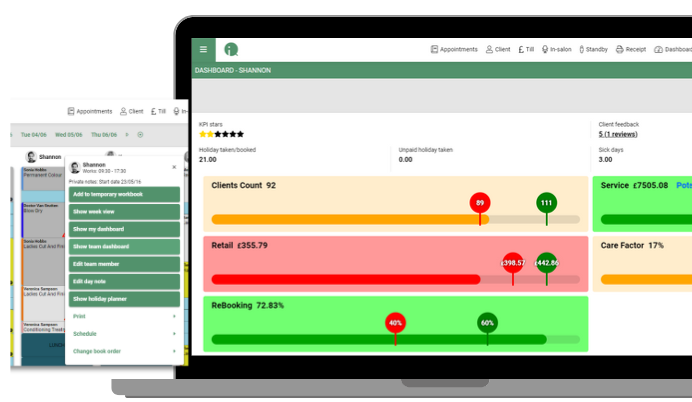
As financial decision-making becomes more closely linked to real-time business insight, embedded finance is emerging as a natural extension of salon management platforms. IQ Finance has been developed within the SalonIQ platform to reflect this shift, bringing finance considerations into the same environment where operational performance is already understood.
Informed by a salon’s actual trading data, IQ Finance is designed to support owners in assessing how access to funding may align with their revenue patterns. By using existing performance insight, it supports clearer visibility when considering financial commitments, rather than relying solely on projections or assumptions.
IQ Finance is intended to sit within a broader framework of responsible financial planning. It does not replace the need for careful evaluation, but aims to support more informed conversations around timing, predictability and control. For salon owners navigating increasingly complex business decisions, this integrated approach reflects how finance and operations are becoming more closely connected.
How do repayments typically work when salon revenue changes?
Repayment structures can vary depending on the type of funding. Some models are designed to adjust in line with trading activity, while others use fixed schedules. Understanding how repayments behave during quieter periods is an important part of responsible financial planning.
Is access to funding suitable for every salon?
Funding decisions are highly individual. Factors such as current performance, existing commitments and future plans all play a role. For some salons, delaying or choosing not to access funding may be the most appropriate option.
What should funding be used for in a salon business?
Funding is often most effective when it supports a clearly defined purpose, such as increasing capacity, improving operational efficiency or investing in long-term infrastructure. Having clarity on intended outcomes can help owners evaluate whether funding aligns with their goals.
How can salon owners assess whether funding fits their cash flow?
Reviewing real trading data, including revenue patterns and seasonal trends, can provide valuable insight. This helps owners understand how financial commitments may interact with the natural rhythm of their business over time.
As the salon industry continues to evolve, financial decisions are becoming more closely tied to visibility, timing and understanding how businesses truly operate. By approaching finance with greater clarity and care, salon owners can make choices that reflect both opportunity and responsibility. This shift toward more informed, data-aware decision-making signals a broader move toward long-term sustainability and control across modern salon businesses.
Call a member of our team today on 01892 280 123